
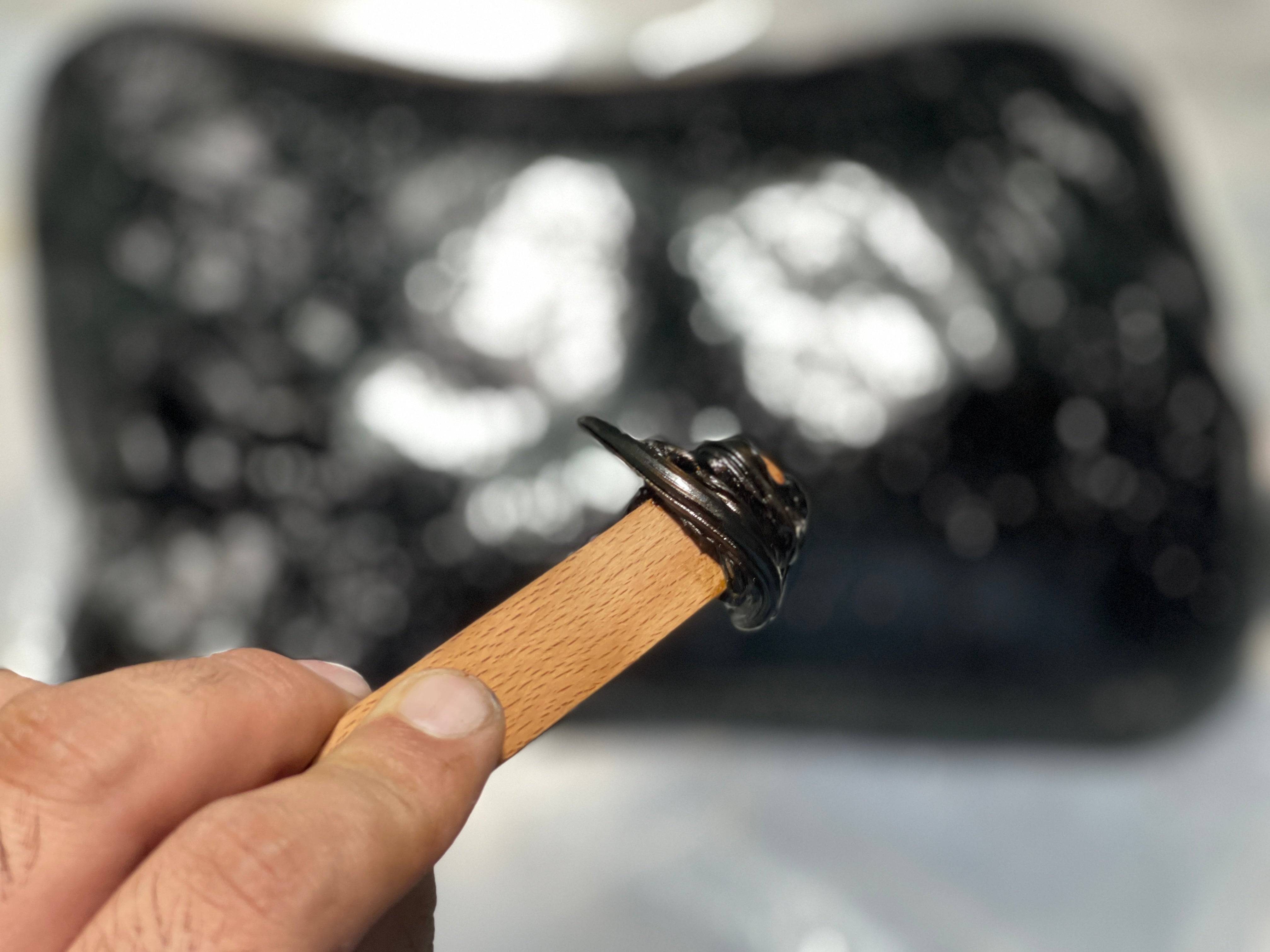
What one serving of shilajit resin actually looks like
Traditional practice and most published usage literature describe a serving of roughly 300 mg to 500 mg of purified resin per day — about the size of a small pea. That is a very small amount, and it is the biggest surprise for first-time buyers: a 10 g jar is not a week of supply, it is roughly 20 to 33 servings.
| Jar size | Servings at 300 mg | Servings at 500 mg |
|---|---|---|
| 10 g | ~33 | ~20 |
| 20 g | ~66 | ~40 |
| 30 g | ~100 | ~60 |
| 50 g | ~166 | ~100 |
| 100 g | ~333 | ~200 |
How to measure a serving without a scale
- A small pea of resin is the standard approximation for a 300 mg serving.
- A matchstick head is a reasonable guide if you prefer to start smaller — many people begin at half a pea and build up over the first week.
- A 0.01 g jewellery scale (a few hundred rupees online) removes all guesswork and takes ten seconds. If you are splitting a jar between two people, it is worth buying.
- Keep the same amount. Consistency matters more than precision; the point of measuring is that you know what you are taking.
How to dissolve shilajit resin properly
- Use warm water, not boiling water. Water you can comfortably drink is enough. Boiling does not make resin dissolve faster — it just makes the drink unpleasant.
- Stir for 30–60 seconds. Resin is sticky by nature; a small whisk, a fork, or pressing it against the side of the glass with the back of a spoon all work.
- Dark flecks are normal. Purified resin is not a clear liquid. Fine sediment and a slight cloudiness are expected — they are part of the resin, not a defect.
- Milk, tea and herbal tea work as well as water. Add the resin after the drink has cooled a little. Some people prefer it in warm milk; others find plain water easiest.
- Skip fizzy drinks. There is no reason to mix resin into a soft drink, and it makes the resin harder to judge by taste if you are checking a new batch.
What is the best time of day to take it?
Traditionally, shilajit is taken in the morning on an empty stomach. There is no controlled research showing that one time of day is meaningfully better than another, so the practical rule is: pick a time you will actually remember.
If you notice mild stomach discomfort or a change in digestion, take it with or just after a meal instead of on an empty stomach. Many people find that a smaller serving with breakfast suits them better than a larger one first thing.
How often should you take it?
Daily use at the serving size is the usual pattern. There is no established need to cycle on and off, and no evidence that taking it every day is better or worse than taking it five days a week. Because there is no long-term safety data for large doses, the sensible approach is to stay within the labelled serving and not to escalate “because nothing happened yet”.
Resin and drops are not the same serving
If you use our liquid shilajit drops, the label calls for 9 drops twice daily — that is the equivalent daily amount in liquid form, not a weight you scoop. Do not use both products at once to double up; pick one and follow its label.
Seven mistakes that waste a jar
- Taking too much. More is not better, and the label serving exists for a reason.
- Judging it after three days. Whatever you are taking it for, give it several weeks before forming a view.
- Boiling the water. Wasteful and unpleasant.
- Storing the jar open. Resin is hygroscopic — it pulls moisture from the air and goes sticky.
- Leaving it on a sunny windowsill. Heat and direct light are the two things to avoid.
- Buying by price alone. The cheap jar is usually the untested one; the lab report is what you are actually paying for.
- Not telling your doctor. If you take any prescription medication, mention it — see the note below.
Storing shilajit resin
Keep the jar sealed, upright, and in a cool, dark cupboard. Room temperature is fine; the fridge is unnecessary and makes the resin hard and awkward to measure. Use a dry spoon every time. If the resin becomes sticky in humid weather, that is normal — it does not mean the batch has spoiled, but it does mean the lid was left off.
When to speak to a doctor first
Check with a qualified healthcare professional before starting shilajit if you are pregnant or breastfeeding, if you take prescription medication, if you have a diagnosed medical condition, or if you are preparing for surgery. Shilajit is a mineral-dense resin and it is a food supplement, not a medicine.
Frequently asked questions
Can I take shilajit resin with coffee?
Yes. There is no known reason to avoid it, though coffee is not ideal for judging the taste of a new batch. Most people take resin in warm water or milk first, then have coffee afterwards.
What does good shilajit taste like?
Bitter, earthy, and slightly smoky, with a faint smell of the mountains and old plant matter. Genuine resin is not sweet and does not taste like chocolate. A sweetness or a burnt plastic note is a sign something has been added.
Can I take shilajit resin at night?
You can, but most people prefer the morning. If you find it affects your sleep, move your serving earlier in the day.
How long does a 30 g jar last?
At one 300 mg serving a day, roughly three months. A 10 g jar is closer to one month. See the table at the top of this guide.
The short version
One small pea-sized serving a day, dissolved in warm water, milk or tea, stored sealed in a cool cupboard. Buy from a producer who publishes third-party lab results for the batch you receive — our lab-tested Himalayan shilajit resin ships with PCSIR and Eurofins results, and you can see the full specification before you order.
Shilajit is a food supplement, not a medicine. It is not intended to diagnose, treat, cure or prevent any disease. Speak to a qualified healthcare professional before use if you are pregnant, breastfeeding, taking medication, or managing a medical condition.