
Most shilajit pages are written to sell. This one is written to answer the question people actually type into Google at midnight: is this safe, and what happens if it is not right for me?
We sell shilajit, so treat this as a page written by a producer who benefits from you buying — and then hold us to the same standard we are about to describe. Everything below is about composition, reported effects and contamination, because those are the things that can actually be checked.
Two different questions get mixed together
There are really two separate safety questions, and confusing them is why you will read both “it is completely natural” and “it is dangerous” on the same evening.
- Question 1: the resin itself. What does purified shilajit do to the body when taken at 300–500 mg a day?
- Question 2: what else is in the jar. Heavy metals, aflatoxins and microbes in resin that was never properly extracted, filtered or tested.
Almost every serious safety concern in this category is a Question 2 problem — and unlike Question 1, Question 2 is completely solvable by buying tested resin.
Side effects people report
Because there is no large, long-term safety trial of shilajit, the honest answer is that the safety picture comes from traditional use plus small studies. The effects most often described by users are mild and short-lived:
- Stomach discomfort — reflux, mild nausea or a change in digestion, especially when taken on an empty stomach.
- Headache in some reports, particularly in the first days of use.
- Loose stools in a small number of people. Mineral-dense resins can have a laxative effect in sensitive guts.
- Allergic reaction — itching, rash or swelling. This is rare but is a genuine reason to stop immediately.
If any of these appear, the reasonable response is to stop taking it and see whether the effect resolves. If you have a reaction that affects your breathing, your face or your throat, treat it as an emergency.
The bigger risk: contamination in untested resin
This is the part that deserves the most attention. Shilajit is a rock-derived resin, so whatever is in the rock is in the material. Resin that is badly extracted, taken from a low-altitude or polluted area, or sold unfiltered can contain:
- Lead, arsenic, cadmium and mercury — the heavy metals that are tested for on every serious product.
- Aflatoxins — mould-derived compounds that can appear in poorly stored plant-derived material.
- Bacteria, yeast and mould — a microbiological panel is standard practice for anything sold as a food.
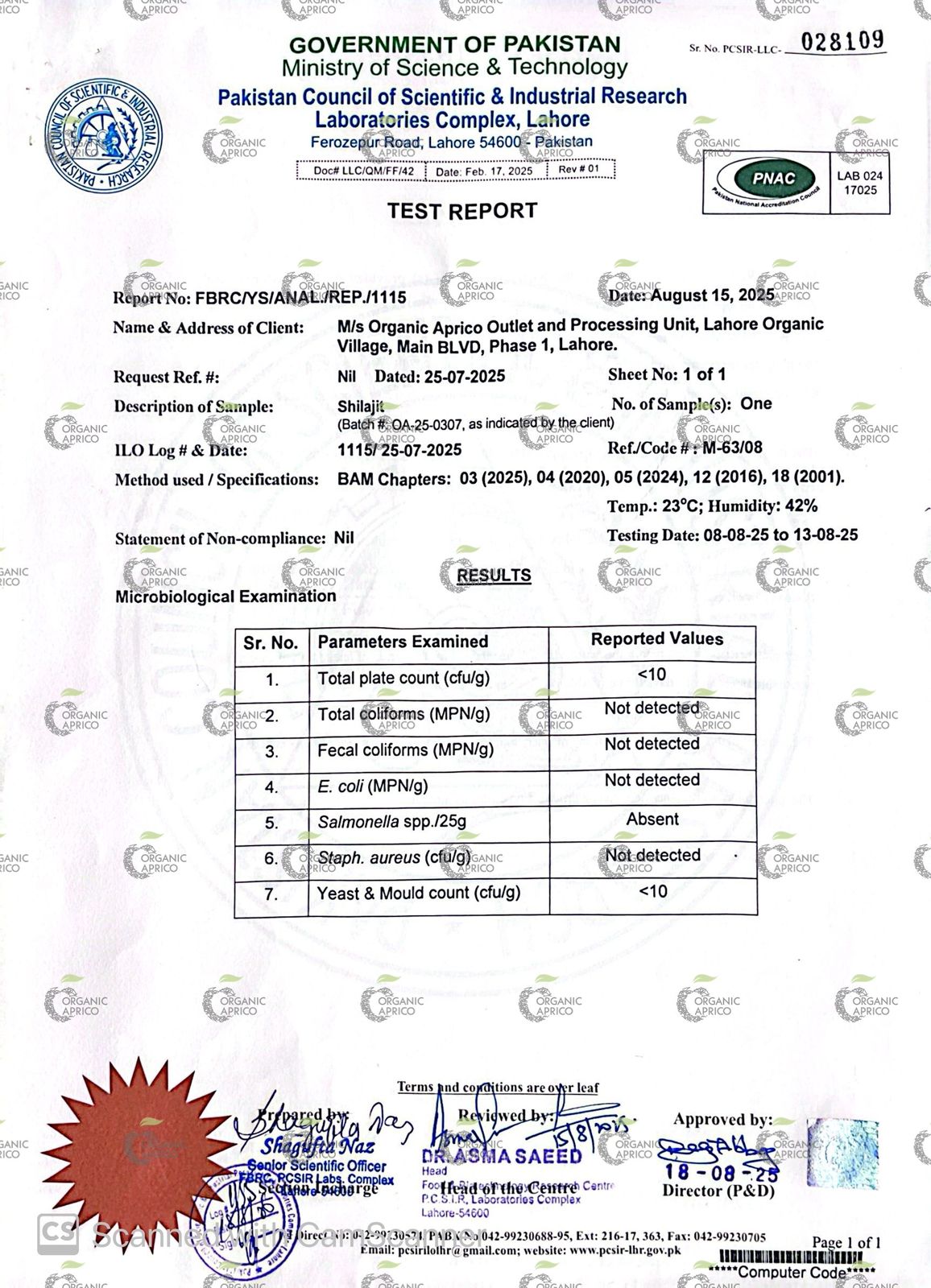
Long-term exposure to heavy metals is a real health risk, and it is invisible: you cannot taste lead. That is why we publish the numbers rather than a claim. Our current Eurofins and PCSIR panels are printed in full on the wholesale shilajit page — lead 0.260 mg/kg, cadmium 0.009 mg/kg, arsenic 0.132 mg/kg, mercury below 0.005 mg/kg on the Eurofins panel, with the PCSIR heavy-metal screen reporting not detected. Compare those figures against any brand you are considering, and be sceptical of a brand that has no figures to compare.
Iron and mineral content
Shilajit is mineral-dense, and iron is one of the minerals naturally present. For most people that is unremarkable. But if you have a condition that causes iron overload — haemochromatosis, for example — or if you have been told to restrict iron, you should speak to your doctor before taking shilajit, and show them the analysis.
Who should avoid shilajit, or check first
- Pregnant or breastfeeding women. There is not enough safety data. Do not take it.
- Children. Not intended for children.
- Anyone taking prescription medication. Interactions have not been well studied. This matters most for blood-pressure and diabetes medication, blood thinners, and anything with a narrow therapeutic window. Ask your doctor or pharmacist first.
- People with kidney or liver conditions. Mineral-dense supplements are handled by these organs; get medical advice rather than assuming.
- Iron-storage disorders. See the section above.
- Anyone having surgery. Stop and tell your surgical team, as a precaution with any supplement.
- Anyone who reacts to a first serving. Stop. Do not push through it.
How to reduce your risk, practically
- Buy tested resin from a producer, not a re-badger. A reseller cannot show you a report for a batch they did not make.
- Ask for the analysis before you order — and check that the batch number on the report matches the jar you receive.
- Follow the labelled serving (300–500 mg of resin a day, or 9 drops twice daily of the liquid). There is no benefit in exceeding it and no safety data at high doses.
- Do not double up. One shilajit product at a time, at the labelled amount.
- Store it sealed, cool and dry. Moisture and heat are the enemy; a dry spoon every time.
- Tell your doctor what you are taking, especially if you are on regular medication or about to have a procedure.
- Stop if something feels wrong. That is always the correct first step, and a producer who argues with you about it is not one to buy from again.
Red flags on any shilajit brand
- No lab reports at all, or a “certificate” issued by the seller itself.
- Claims to treat, cure or prevent a disease — illegal for a food supplement in Pakistan, the UK and the EU, and a strong signal of a marketing-first operation.
- A price per gram far below the market: check what is missing.
- No batch number, or a report that is not tied to a specific production run.
- No address, no named producer, and no way to visit the facility.
- A serving size expressed vaguely as “a spoon” rather than in milligrams.
Frequently asked questions
Can shilajit damage your kidneys or liver?
There is no evidence of purified shilajit harming healthy kidneys or liver at labelled servings, but there is also no long-term trial that proves the opposite with certainty, and contaminated products are a separate risk. If you have a kidney or liver condition, take medical advice before using it.
Is shilajit safe to take every day?
Daily use at the labelled serving is the common pattern and is what traditional practice describes. Because long-term safety data for high doses is lacking, stay within the label rather than escalating.
What should I do if I feel unwell after taking it?
Stop taking it, and speak to a healthcare professional — and mention that you were taking a mineral-dense resin, so they have the full picture. If you have difficulty breathing or swelling of the face or throat, seek emergency care.
Is shilajit safe for women?
There is no reason to think purified, tested shilajit is unsafe for women generally, but pregnancy and breastfeeding are an absolute no — there is not enough data. If you are managing a medical condition or taking medication, ask your doctor first.
Does the source altitude matter for safety?
It matters for contamination risk. High-altitude Himalayan resin from an unpolluted source has less industrial and agricultural exposure, and it is where traditional extraction happens. Purity still has to be demonstrated by testing, not assumed from the mountains.
The bottom line
For most healthy adults, the realistic risk with shilajit is not the resin — it is the jar with no lab report. Choose a producer who publishes third-party results for the batch you buy, follow the labelled serving, keep clean storage, and take medical advice if you are pregnant, medicated or managing a condition.
Our purified Himalayan shilajit resin is extracted above 17,000 ft in Skardu and tested by PCSIR, Eurofins and Micro Quality Lab. The full specification is published before you buy, and our certifications and lab reports are open for inspection.
Shilajit is a food supplement, not a medicine. It is not intended to diagnose, treat, cure or prevent any disease. This article is general information and is not medical advice. Speak to a qualified healthcare professional before use if you are pregnant, breastfeeding, taking medication, or managing a medical condition.